Full-arch implant solutions at Lambton Dental
For patients missing most or all of the teeth in an arch, a small number of dental implants can support a full set of replacement teeth. At Lambton Dental in West Toronto, the dentist plans full-arch implant options end-to-end so results look natural, chew reliably, and clean well every day.

What are full-arch implant solutions?
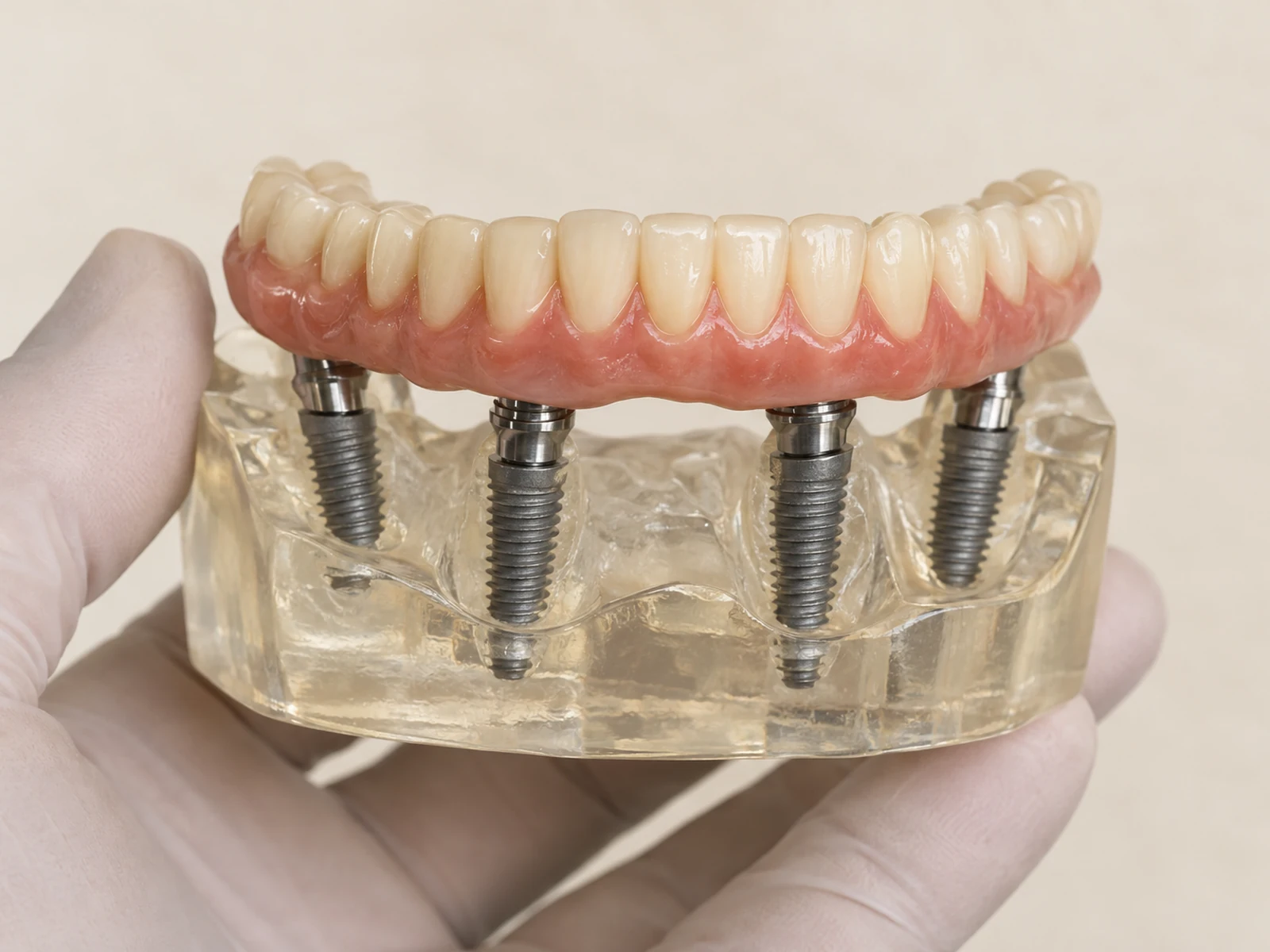
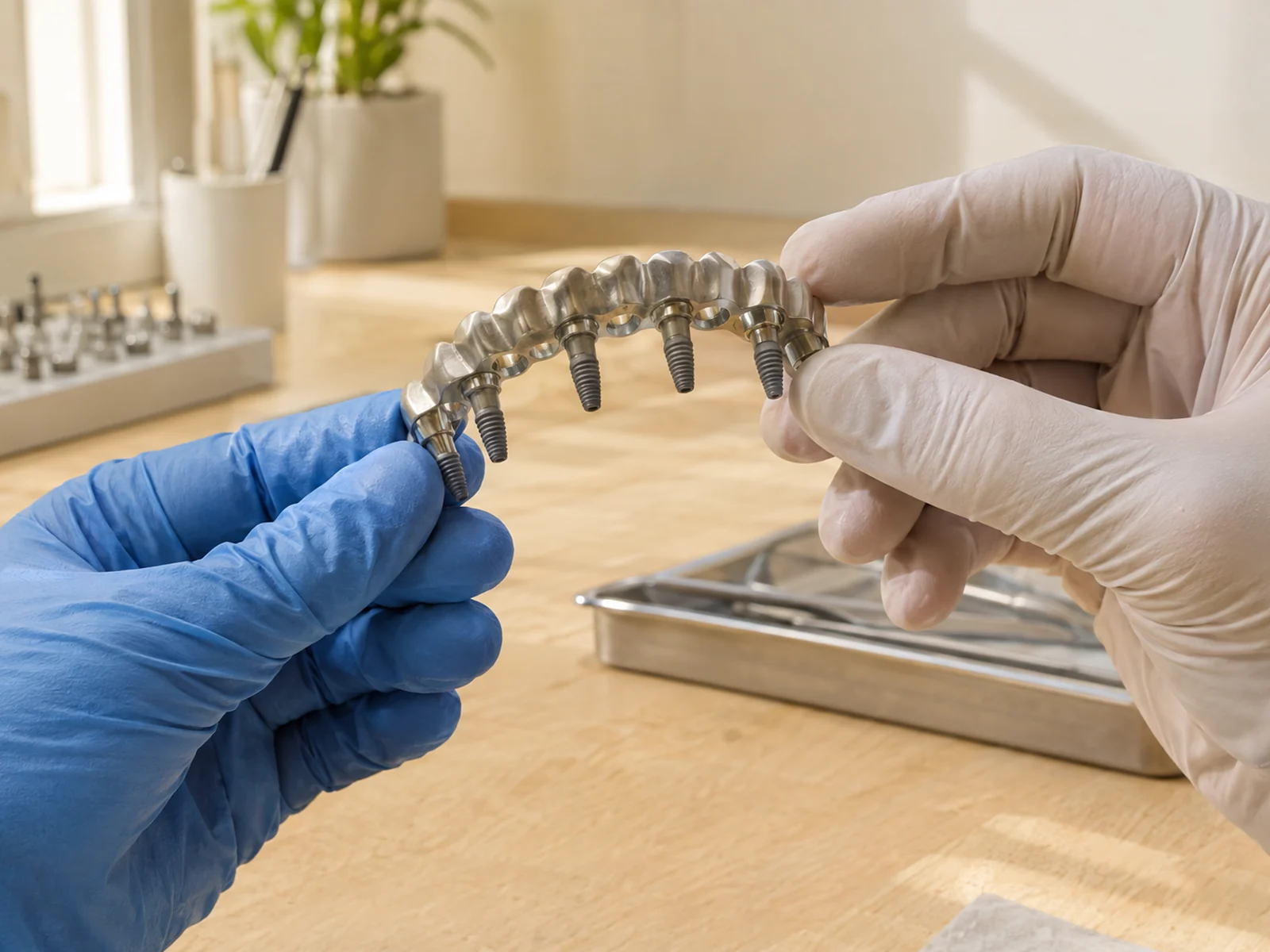
A full-arch implant solution replaces every tooth in an arch — upper, lower, or both — using dental implants as the foundation rather than resting the prosthesis on the gums. Two common approaches are used at Lambton Dental. A fixed implant-supported bridge, sometimes called a hybrid prosthesis, is anchored to a small number of implants (commonly four to six per arch) and stays in the mouth full time. An implant-retained overdenture uses two or more implants to hold a removable denture firmly in place with clips, locators or a bar; it is taken out at home for cleaning but is far more stable than a conventional denture.
Both approaches use the same underlying principle: implants transfer chewing forces into the jawbone the way natural roots do, which helps preserve bone shape and delivers a more secure bite than a denture that sits on the gums alone.
When a full-arch implant solution is the right choice
A full-arch implant option may be worth discussing when:
- You are missing most or all of the teeth in an arch, or the remaining teeth are not restorable and need to be removed.
- You wear a conventional denture that moves, is uncomfortable or has affected what you can eat, and you would like a more stable solution.
- You would like to avoid a denture that covers the palate on the upper jaw.
- You have adequate bone volume, or are willing to consider grafting or an angled implant approach to work with the bone available.
- Your general health supports elective implant surgery, which the dentist reviews with you at the consultation.
If a smaller number of teeth are missing, a single-tooth implant, a bridge or a partial denture may be more appropriate. The dentist explains the trade-offs honestly in a written plan before anything proceeds.
What to expect with full-arch implants at Lambton Dental
- 1
Complimentary implant consultation
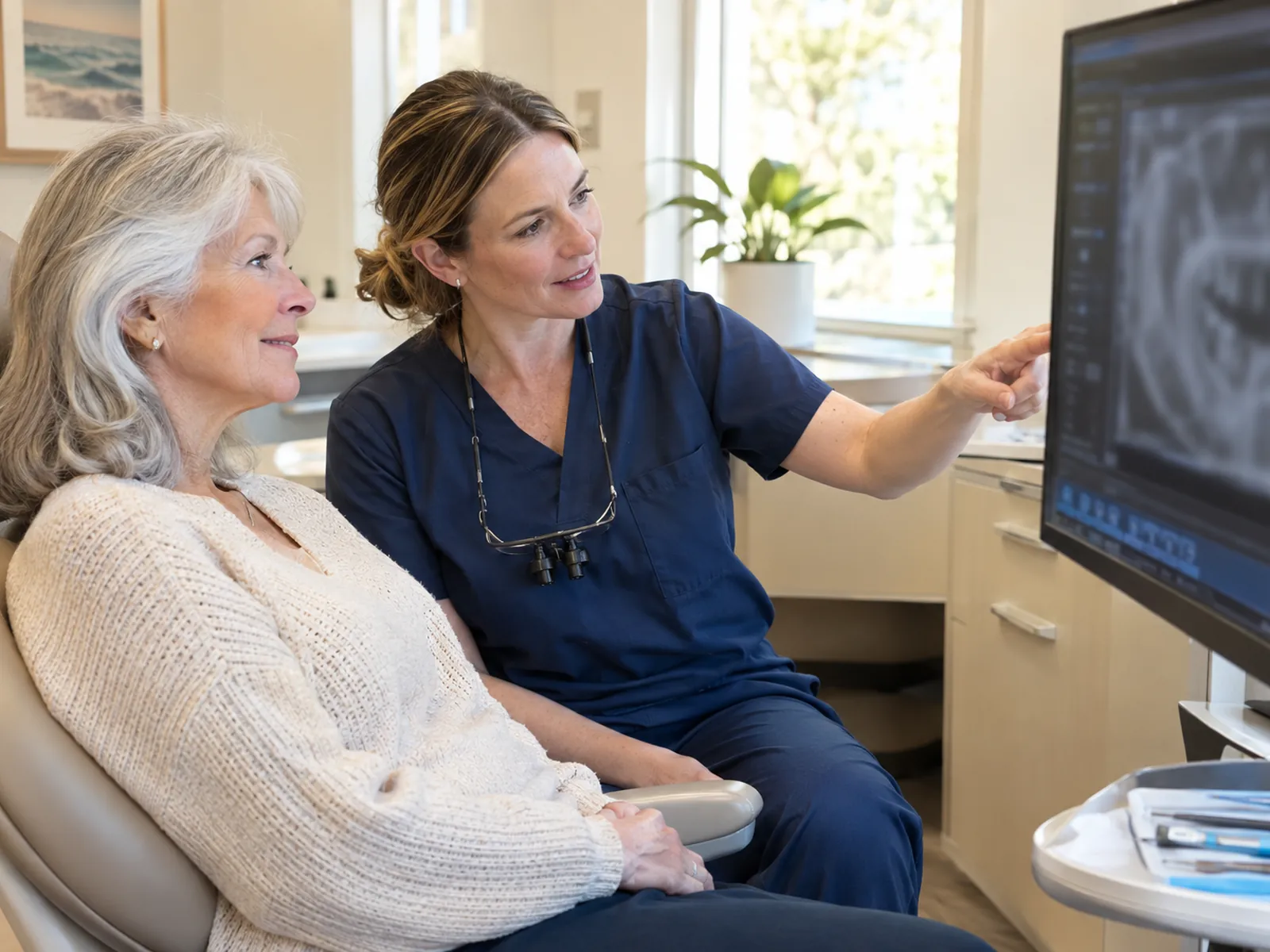
The dentist examines the arch, reviews your dental and medical history and takes appropriate imaging, then explains which full-arch approaches are suitable for you.
- 2
Planning with 3D imaging
A cone-beam CT scan is used to plan implant number, position and angulation digitally, so the implants and the final prosthesis are designed together.
- 3
Extractions and site preparation
Any remaining non-restorable teeth are removed and, where needed, the site is prepared with grafting. In selected cases the implants are placed at the same visit.
- 4
Implant placement
Under local anaesthetic — with sedation available if you prefer — the planned implants are placed into the prepared arch. A temporary prosthesis may be delivered depending on the case.
- 5
Healing period
The implants integrate with the bone over roughly three to six months. You are seen along the way, and the temporary is adjusted as needed for comfort and appearance.
- 6
Final prosthesis
Once healing is complete, the final fixed bridge or overdenture is fitted, the bite is checked and adjusted, and you are taught how to clean and care for it at home.
Nitrous oxide, oral sedation and IV sedation are available for anxious patients; the dentist reviews your health history first. See our sedation options page for more.
Living with a full-arch implant restoration
Mild swelling, tenderness and bruising around the implant sites are common for several days after placement, and most patients manage well with the guidance and any medication the dentist provides. Soft foods, cool compresses, gentle rinsing with warm salt water and avoiding smoking are usually recommended during early healing. If a site feels unusually painful, keeps bleeding or the temporary feels loose, please contact us so it can be checked promptly.
Once the final prosthesis is delivered, day-to-day care depends on which option you have. A fixed implant bridge is cleaned in the mouth with specialised brushes, water flossers and threader floss along the underside; the dentist and hygienist will show you exactly how. An implant-retained overdenture is taken out at home for cleaning and the underlying attachments are brushed gently. Both options should be checked at regular professional cleaning visits so the implants, prosthesis and gum tissues stay healthy, and a night guard may be recommended if you grind.
Cost, insurance, and financing for full-arch implants
Full-arch implant treatment is a significant investment, and the cost depends on the number and type of implants, whether grafting is needed, the material of the final prosthesis and whether a fixed or overdenture option is chosen. A full written estimate is provided after the complimentary consultation, and monthly financing is available for treatment plans that need it, so the decision is unhurried.
We accept all major Canadian dental insurance carriers and direct-bill wherever your plan allows. Implant coverage varies widely between plans, and full-arch treatment often spans more than one plan year; where useful, we submit a pre-determination and can help you stage treatment to work with your annual maximum. Lambton Dental is also a provider for the Canadian Dental Care Plan (CDCP) and the Interim Federal Health Program (IFHP); coverage for implants under these programs depends on your eligibility and the specific procedure codes, and we will confirm what applies before your appointment.
For patients without insurance, our payment options page explains billing and monthly financing openly.
For larger treatment plans, monthly payment plans through a third-party financing partner are available on approved credit — ask at your consultation or see our payment options.

Why patients choose Lambton Dental for full-arch implants
- Every case is planned with digital 3D imaging so implants and the final prosthesis are designed together, not separately.
- The dentist reviews fixed and overdenture options honestly so you can weigh the trade-offs for your mouth, lifestyle and budget.
- Comfort is a priority: topical numbing, gentle freezing and, for anxious patients, sedation options are available after a health review.
- We direct-bill CDCP, IFHP and major insurance carriers wherever your plan allows, submit pre-determinations for major work and offer monthly financing.
- Evening and weekend appointments make it easier to fit the staged visits around your schedule.
- Our team serves patients in English, French, Italian, Spanish, Portuguese, Hindi, Punjabi, Urdu, Tagalog, Vietnamese, Ukrainian, Mandarin and Cantonese.
Related services
Frequently asked questions about full-arch implants
How is a full-arch implant bridge different from dentures?
A conventional denture rests on the gums and can move during eating and speaking, especially in the lower jaw. A full-arch implant bridge is anchored to implants integrated with the jawbone and stays in the mouth full time, so it does not shift and generally allows a wider range of foods. An implant-retained overdenture is a middle-ground option — removable at home, but held firmly in place while it is being worn.
How many implants are needed per arch?
A fixed full-arch bridge is commonly supported by four to six implants per arch, depending on bone volume and bite forces. An implant-retained overdenture may need only two to four. The exact number is planned digitally after the imaging so it matches your anatomy and the type of prosthesis chosen.
How long does the full process take?
Most full-arch cases take several months from implant placement to the final prosthesis, most of which is healing time while the implants integrate with the bone. A temporary is usually worn during that time. Cases that need grafting or complex extractions take longer, and the dentist gives you a realistic timeline after the consultation.
Do you offer same-day teeth on implants?
In selected cases, a temporary fixed prosthesis can be delivered on the same day the implants are placed, so you leave the appointment with fixed teeth. Whether this is appropriate depends on bone quality, implant stability at placement, general health and case complexity. The dentist reviews suitability with you at the consultation.
Am I a candidate if I have been told I do not have enough bone?
Not having enough bone in one area does not always rule out treatment. Options such as bone grafting, sinus lift procedures or angling implants to make use of the bone available can widen the range of patients who can be treated. Imaging and a careful exam are needed to know what is realistic for you.
How do I clean an implant bridge or overdenture?
A fixed implant bridge is cleaned in place daily using a soft toothbrush, threader floss or super floss under the bridge, a water flosser and specialised interdental brushes. An overdenture is taken out at home for cleaning, and the underlying attachments are brushed gently. Regular professional cleanings are essential — the hygienist teaches and reinforces the technique tailored to your prosthesis.
Is treatment covered by insurance, CDCP or IFHP?
Coverage varies. Some private plans cover part of the surgical or prosthetic side and often have an annual maximum that affects timing. CDCP and IFHP coverage for implants depends on eligibility and the specific procedure codes. We submit pre-determinations where useful and help stage treatment across plan years or with monthly financing when needed.
Book your complimentary implant consultation
New patients can start with a complimentary implant consultation. The dentist will assess suitability for a fixed implant bridge or an implant-retained overdenture, discuss timeline and options, and provide a written treatment plan and quote. There is no obligation to book further treatment.
CDCP welcome
We welcome patients covered under the Canadian Dental Care Plan and can help you understand what's covered.
Learn about CDCP →IFHP welcome
We are registered to treat patients under the Interim Federal Health Program and bill Medavie Blue Cross directly.
Learn about IFHP →Direct billing
We bill all major Canadian dental insurance carriers directly, so you pay only what your plan does not cover.
How direct billing works →